The A in LGBTQIA+ stands for asexual, aromantic and agender, not ally. What these orientations mean, where they differ, and why their visibility at Pride matters.
Plenty of people still think the A in LGBTQIA+ stands for ally. It doesn't. The A stands for asexual, aromantic and agender. And the people behind that letter are more common than the confusion suggests.
Two identities that often get confused
Asexuality and aromanticism are two different things. Asexual people feel little or no sexual attraction to others. Aromantic people feel little or no romantic attraction, which means they rarely or never fall in love. The two can overlap, but they don't have to. Many asexual people fall in love without wanting sex.
That distinction has a name: the split attraction model. It separates romantic orientation from sexual orientation. An asexual person can still be heteroromantic, homoromantic, biromantic or panromantic. An aromantic person can have any sexual orientation.
Not celibacy, not a disorder
Asexuality is not a choice, the way celibacy is, and it is not a dysfunction. The DSM-5, the diagnostic manual used in psychiatry, explicitly lists self-identification as asexual as a reason not to diagnose a sexual desire disorder. Asexual people can and do have sex, out of curiosity, to have a child, or to be close to a partner. What is absent is the attraction, not the capacity.
The Trevor Project estimates that around 10 percent of LGBTQ youth identify as asexual or somewhere on the ace spectrum. That is a lot of people who spent years thinking something was wrong with them before they heard the word.
A spectrum, not a category
Asexuality and aromanticism are spectra. Some people are demisexual or demiromantic: attraction only appears once a deep emotional bond exists. Others are grey-asexual, feeling attraction rarely or only weakly. The umbrella term for all of it is aspec.
Relationships don't follow one script either. Queerplatonic relationships are close bonds that sit outside the usual lines between friendship and romance, and for many aspec people they carry the same weight as a partnership.
How the community became visible
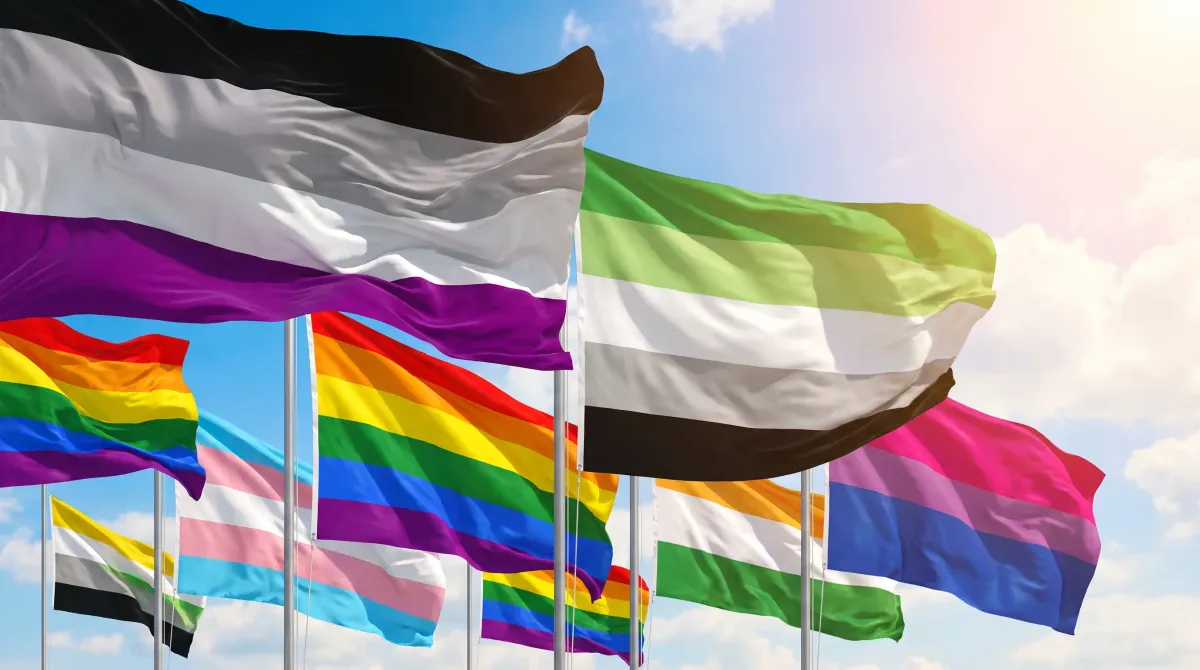
The modern asexual community formed in the 1990s and grew online. In 2001 David Jay founded the Asexual Visibility and Education Network, AVEN, still the largest asexual organisation. The asexual flag dates from 2010: black for asexuality, grey for the spectrum, white for sexuality, purple for community. The aromantic flag followed in 2014, with green as the opposite of romantic red.
Discrimination against aspec people mostly looks like invisibility. In the Aro Census 2020, 82 percent of respondents said their most common experience was not being taken seriously, ignored or dismissed. Asexual people regularly hear that they just haven't met the right person, or that their orientation is a phase, a trauma response or a medical problem.
What this means at Pride
Pride can be the first place an ace or aro person sees their orientation named and their community exist. That is why inclusion matters, beyond just carrying the letter in the acronym. A good start is believing people: if someone says they are asexual, they are the expert on themselves.
At a march you will see the black, grey, white and purple flag for asexuality, and green, light green, white, grey and black for aromanticism. Both groups have been part of the community all along. They would be there with or without the flags.
Frequently asked questions
Last reviewed: 4. September 2026