23 September is Bi Visibility Day. Who started it, what the pink, purple and blue flag stands for, and how you can make bisexual people visible at Pride and in everyday life.
Every 23 September, pink, purple and blue flags show up on social media, and some people ask: why does bisexuality need its own day when Pride is for everyone? The answer sits in a problem many bi people know well. They get overlooked, because nobody can see their orientation and they are read as gay, lesbian or straight depending on who they date. This piece explains where Bi Visibility Day comes from, what the bi flag means and what you can do at Pride and in everyday life. Information as of October 2026.
What the day is for
Bi Visibility Day, also called Celebrate Bisexuality Day, takes place every year on 23 September. Three bisexual activists started it in 1999: Wendy Curry from Maine, Michael Page from Florida and Gigi Raven Wilbur from Texas. According to reports, it was first observed at the conference of the International Lesbian and Gay Association in Johannesburg.
Why 23 September depends on who you ask. One account says it is Gigi Raven Wilbur's birthday, and that she first proposed the idea. Another source says September was chosen to honour Freddie Mercury, who was born in September 1946. The two explanations don't contradict each other, but the only firm fact is that the day falls on that date and came from the community itself.
The name "Bi Visibility Day" comes from the British activist Jen Yockney. It has spread well beyond Europe.
Why visibility matters
Bisexuality means being attracted to more than one gender. Even so, many bi people hear the same line again and again: "You'll have to pick a side eventually."
That has a name: biphobia. It covers prejudice that treats bisexuality as a phase, as indecision or as a stop on the way to being gay or lesbian. Bi activists also talk about bi erasure, the way bisexual people are made invisible. If someone is in a relationship with the opposite sex, they are quickly assumed to be straight; if it is the same sex, gay or lesbian. That both can be true of one person gets lost.
Michael Page, one of the founders of the day, says he designed the bi flag after talking to many bi women and men who felt no connection to the rainbow flag. That tells you something too: the wish to be seen came from the people themselves.
From community date to official day
For a long time the day stayed a community affair. In 2012 Berkeley, California, became the first city to proclaim 23 September Bi Visibility Day officially. In 2013 the White House invited about 30 bisexual advocates to a meeting on that day. In 2021 Pennsylvania's governor Tom Wolf became the first US governor to recognise it officially. All three examples come from the United States.
The bi flag
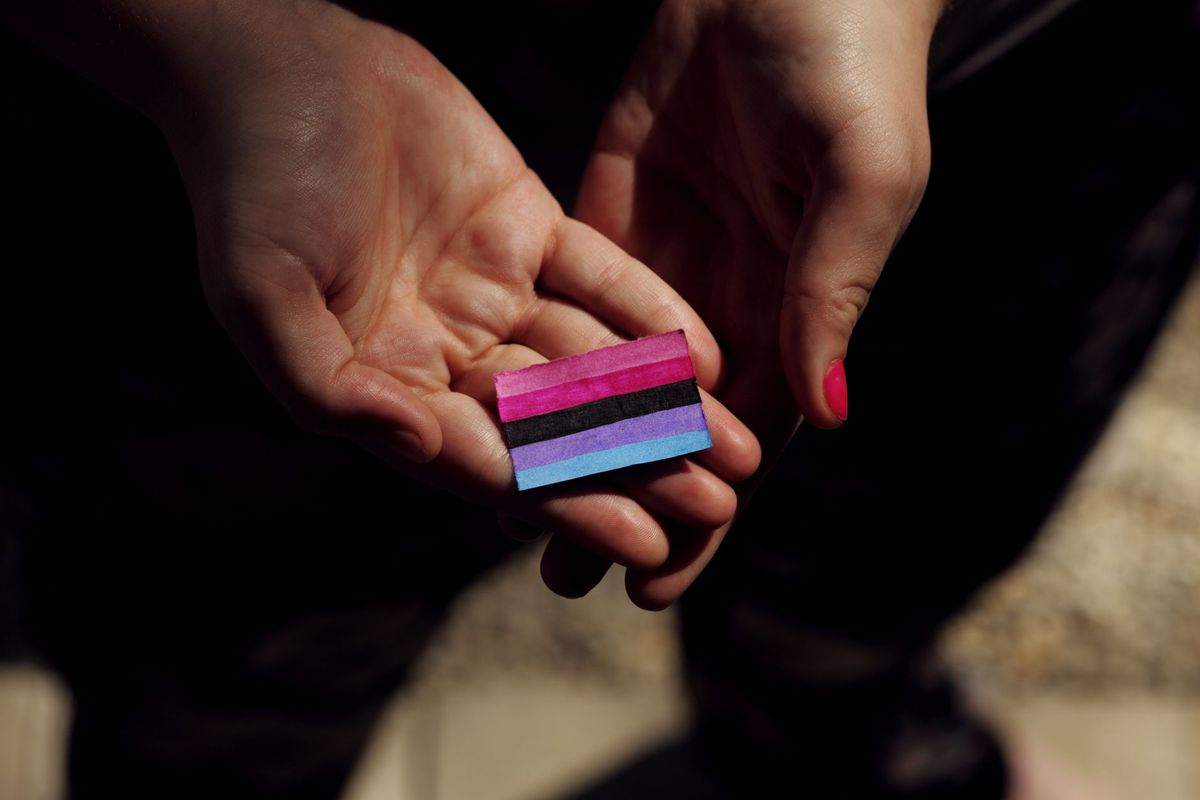
The flag was unveiled on 5 December 1998 at the first-anniversary party of the BiCafe. One source gives 1999 in Philadelphia instead, which is less well supported. The flag has three stripes: a wide pink one on top, a wide blue one at the bottom and a narrow purple one in the middle.
Page explained the colours like this: pink stands for attraction to the same sex, blue for attraction to the other sex. Purple comes from the overlap of the two and stands for attraction to both. The purple also blends into pink and blue, much as bi people can pass unnoticed in both the gay and the straight world. Newer texts describe the purple as attraction to all genders, including non-binary people, so the reading varies.
The colours trace back to the biangles, a symbol Liz Nania designed for the bisexual contingent at the 1987 March on Washington: a pink and a blue triangle that overlap in lavender.
What you can do
- Don't ask when someone will "decide". Anyone who calls themselves bi has already decided.
- Don't read orientation off a relationship. A man dating a man can be bi, and a woman with a girlfriend isn't automatically a lesbian.
- Think of bi people at Pride. Bi flags and bi groups belong in the picture. If you plan a stall or a speech, invite them by name.
- Listen. If someone says they don't feel seen on the scene, that is true for that person.
In short
Bi Visibility Day is a reminder that bisexual people belong to the community even when you can't tell by looking. The flag with its three stripes gives them a sign of their own.
Frequently asked questions
Last reviewed: 20. October 2026