In August 1966, trans women and drag queens in a San Francisco cafeteria fought back against police harassment. What is documented, what is not, and why the story came back so late.
Three years before Stonewall
Ask where the modern queer movement began and most people say the Stonewall riots of June 1969 in New York. Three years earlier, in San Francisco, there was an uprising that almost nobody recorded: the one at Compton's Cafeteria. It took place in August 1966. Which night is unknown. There was no press coverage, and according to Wikipedia the city's police records from the 1960s no longer exist. We know about it largely thanks to the research of the historian Susan Stryker.
The place and the people
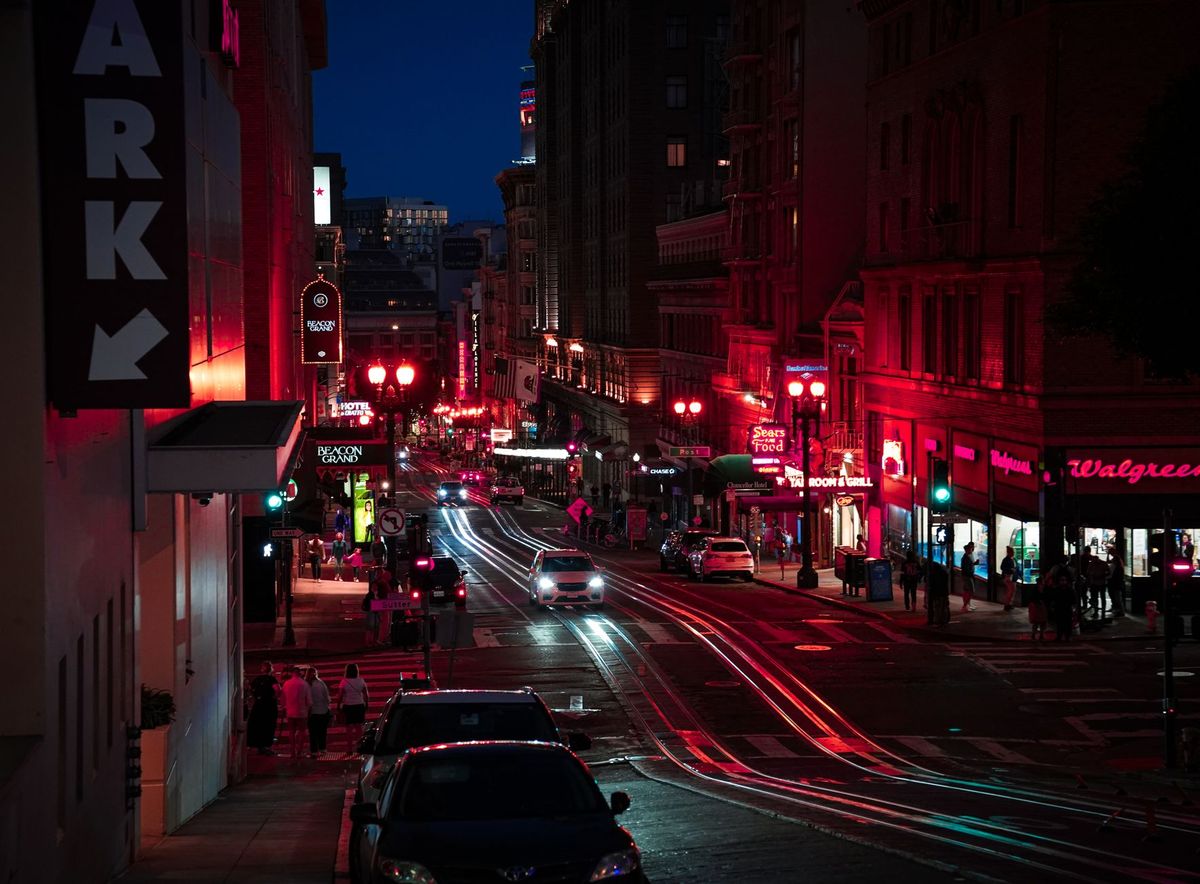
Compton's Cafeteria stood at 101 Taylor Street, at the corner of Turk Street, in the Tenderloin district. It operated from 1954 to 1972 and was open around the clock. It was a gathering place for trans women and drag queens, who had few other places to go. Here they could sit late into the night.
The law made that risky. Police regularly arrested people for "female impersonation" under a city law against wearing clothing of the other sex, which was not repealed until 1974. Compton's management often called the police on trans and drag customers and added a service charge aimed at them.
What happened that night
On 19 July 1966 Vanguard, a queer youth group, had picketed the cafeteria. The picket achieved nothing. About a month later, in August, a worker called the police about rowdy customers. When an officer tried to arrest a trans woman, she threw coffee in his face. Objects flew and windows broke. The police retreated to the street to call for backup. A police car was damaged and a newsstand burned. Officers then tried to load people into paddy wagons.
The next day protesters came back and smashed the new plate-glass windows again. Officer Elliott Blackstone later said that police had used "unnecessary violence" that night.
What came next
In early autumn 1966 Vanguard held a "street sweep": about fifty members pushed borrowed brooms through the Tenderloin to protest police sweeps of queer neighbourhoods. In 1968 the National Transsexual Counseling Unit was founded, funded by the Erickson Educational Foundation and active until 1974. It is said to have been the first peer-run counselling service of its kind, according to Wikipedia. Compton's itself closed in 1972.
Why the date is missing
That the exact day cannot be pinned down is part of the story. There were no newspaper reports and no surviving police files, only the memories of people who were there. One participant recalled a hot weekend night; that is a recollection, not a documented date. Careful sources therefore say "August 1966" and nothing more. Anyone who names an exact night is adding something that is not documented.
How the story came back
The historian Susan Stryker rediscovered the uprising, which had been largely lost to history, and in 2005 made the documentary Screaming Queens with Victor Silverman. Since then, remembrance has grown in several steps:
- On 24 June 2016 the block was renamed Gene Compton's Cafeteria Way.
- In August 2016 the 50th anniversary of the uprising was marked, the same year as the renaming.
- In 2017 San Francisco recognised the Compton's Transgender Cultural District, renamed The Transgender District in March 2020.
- On 27 January 2025 the National Park Service added the building to the National Register of Historic Places. Reports on this rest on press coverage, not on an announcement from the agency.
Sources give the address differently (101, 101-102, 111 Taylor Street). If you go looking for the building, use the street name and the commemorative plaque as your guide.
Why the uprising belongs in Pride history
Many see the uprising as a precursor to Stonewall because it shows that resistance to police violence was not limited to one night or one city. In this case it came from trans women and drag queens. Calling it the start of the modern movement is an interpretation, not a fact.
For your own Pride day this changes nothing practical. It only means that behind the parade stands a series of nights like this one, and some of them have been known for just a few decades. To learn more, watch Screaming Queens or read the reporting by KQED and the Bay Area Reporter on the National Register listing.
Frequently asked questions
Sources
- en.wikipedia.org · Compton's_Cafeteria_riot
- lgbtqnation.com · trans-landmark-added-to-national-register-of-historic-places...
- kqed.org · sf-site-of-comptons-cafeteria-uprising-could-get-expanded-hi...
- kalw.org · compton-cafeteria-awarded-landmark-designation
Last reviewed: 27. October 2026