
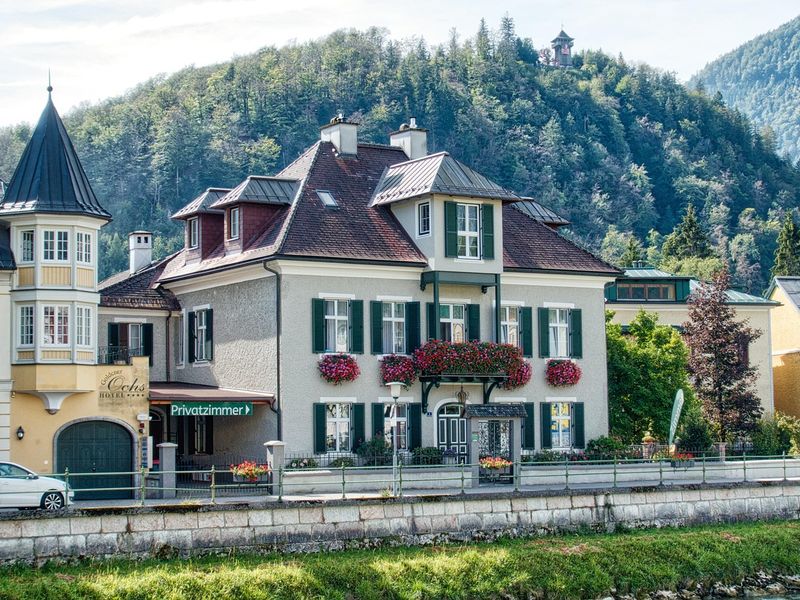
Bad Ischl Pride 2026
Bad Ischl Pride programme
Hotels around Bad Ischl
Tap the map for prices and availability.
About Bad Ischl Pride
In the Salzkammergut, a region better known for postcard lakes and alpine scenery than for nightlife, a Pride event has carved out its own place: Salzkammerpride in Bad Ischl. It is organized by the association Aufbruch Salzkammergut, whose volunteer team operates under the project name Salzkammerqueer.
The parade traditionally sets off in front of the town's historic post office building. From there, the route runs along Kaiser-Franz-Josef-Strasse, past Kreuzplatz, through Wirerstrasse, and on via the Esplanade and Kaltenbachstrasse. It ends at Sissipark, near the water playground, where a Pride Village takes over the grounds for the rest of the day.
The park hosts a stage program alongside information and sales booths run by queer initiatives and associations from the wider region. Those who want to get in the mood a day early can head to the cinema in nearby Ebensee, where an evening program of short films, a locally awarded film prize, a filmmaker talk, and a small pre-party set the tone.
Once the stage program wraps up, the celebration moves on to the Trinkhalle, a historic spa building turned dance floor for the night. At past editions, police estimates put attendance in the low thousands, a notable turnout for a spa town of this size.
The whole event runs on volunteer effort. The organizing team describes itself, in its own words, as a colorful little group of committed queer people and allies, a description that fits the atmosphere of Salzkammerpride: unpretentious, direct, without heavy commercial branding. Visitors who usually associate the region with lake cures and operetta romance get, for one day, a very different and equally warm side of Bad Ischl. Between the imperial villa and the old town, for a few hours each year, a parade insists that queer life belongs in small towns too, not only in provincial capitals.
About Bad Ischl
Bad Ischl has its own Pride: SalzkammerPride, the first Pride parade in the Salzkammergut. It grew out of the Salzkammerqueer project, launched when the Salzkammergut, with Bad Ischl, was European Capital of Culture. The idea was carried by a team from the region, including the Frauen*forum Salzkammergut in Ebensee and the girls' and women's centre Insel in Scharnstein.
Even the first edition drew around two thousand people, according to the police. The parade starts at the old post office building and runs through the centre of Bad Ischl. It ends in Sisipark, where the Pride Village is set up afterwards. There is live music, DJ sets, drag, readings, poetry slam and a programme for children. In the evening an after-show party follows in the Trinkhalle.
Pride has since become a recurring event and has grown: the third SalzkammerPride was extended to two days for the first time, with a film evening and a pre-party at the cinema in Ebensee the night before. Date and programme are announced anew each year, usually via the Salzkammerqueer website and the SalzkammerPride Instagram profile.
For many participants the parade carries personal meaning. People who grew up in the Salzkammergut say that nothing like it existed when they were teenagers. Others travel from other parts of Upper Austria to stand up for the rights of queer people. Not everyone in the region welcomes Pride; there was criticism from local politicians even before the first parade.
If you are looking for a larger Pride, you will find it in Linz. Linz Pride has its own team and its own parade in early summer, organised around HOSI Linz.
Bad Ischl Pride – frequently asked questions
Start in front of the Bad Ischl post office building, continue along Kaiser-Franz-Josef-Straße, past Kreuzplatz, through Wirerstraße, over the Esplanade and Kaltenbachstraße to Sissipark near the water playground. Duration about an hour.
Nearby Prides
Graz Pride 2027
Munich Pride 2027
From the magazine
Gilbert Baker and the First Rainbow Flag: Eight Stripes, 1978
How a request from Harvey Milk became the rainbow flag, why it began with eight stripes, and what survives of the two originals.
The Wolfenden Report 1957: Why Britain Needed Ten Years to Decriminalise Gay Sex
In 1957 a committee recommended ending criminal penalties for private sex between consenting adult men. The Sexual Offences Act followed only in 1967 and covered just England and Wales.
Toronto 1981: The Bathhouse Raids and the Protests Behind Toronto Pride
On 5 February 1981 Toronto police raided four gay bathhouses and arrested close to 300 men. What happened, how the sources count it, and how the protests connect to Toronto Pride.