
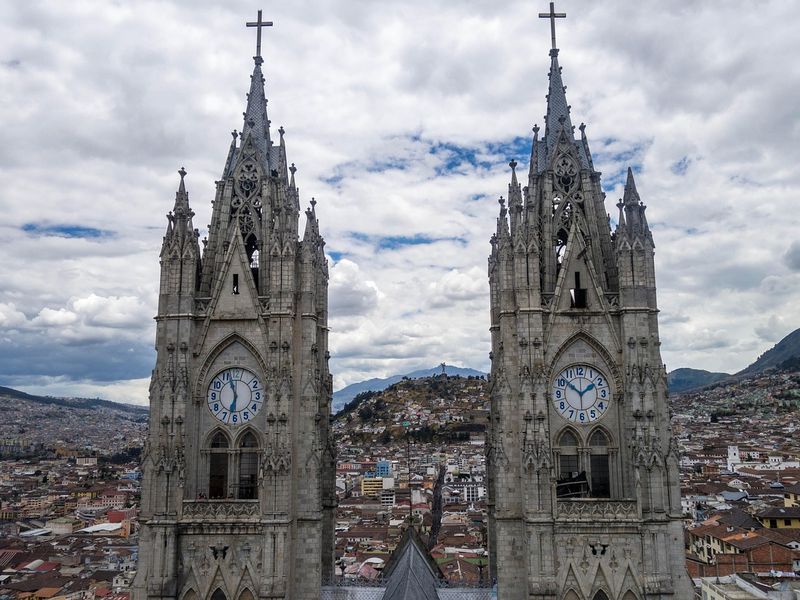
Hotels around Quito
Tap the map for prices and availability.
About Quito
Quito's Marcha del Orgullo is one of the oldest Pride marches in Ecuador. It began modestly: just one year after Ecuador removed homosexuality from its criminal code, around twenty people walked through the capital. The first march was organised by the Fedaeps foundation together with a national network of lesbian, gay and trans groups. It set off from Parque El Arbolito and crossed the historic centre.
Later the Fundación Equidad took over the organisation, and the march kept growing. A few hundred participants became thousands, then tens of thousands; one of the more recent editions drew around 25,000 people. The route changed with the size. For several years the march ran through the La Mariscal district and ended at Plaza Foch, briefly returned to the historic centre and eventually settled in the north of the city around Parque La Carolina.
Today Quito has two marches. After internal disagreements the organising groups split: Orgullo Quito holds one march on a Saturday in June, and the Orgullofff collective holds another a week later. Orgullo Quito most recently gathered at the Plataforma Gubernamental Norte and marched north along Avenida Río Amazonas to the events grounds at Parque Bicentenario, followed by a free concert with Ecuadorian artists. The organisers asked participants to keep the march peaceful, avoid confrontation and look out for each other.
If you want to join, follow the current announcements of both groups, since the date, meeting point and route are set anew each year. Quito sits at about 2,800 metres, and the organisers recommend comfortable shoes, sun protection and rain gear, as the weather can turn within an hour. The march remains both a street celebration and a political demonstration for equal rights and against violence and discrimination.
Quito Pride – frequently asked questions
From the magazine
Magnus Hirschfeld and His Institute: What Was Lost on 6 May 1933
Long before Stonewall, Berlin had a place where homosexual people found advice and recognition. How the Institute for Sexual Science began and why it was destroyed in 1933.
Harvey Milk and Proposition 6: The November 1978 Victory
In 1978 a California ballot measure would have forced queer teachers out of public schools. Harvey Milk fought it, and voters rejected it. What happened and what it has to do with Pride.
Brenda Howard and the Pride Week: Who Turned a Memorial March into a Tradition
After Stonewall, a march marked the anniversary in 1970, and later a whole week. Brenda Howard is named as one of the people behind it. What is documented and where the title Mother of Pride stays disputed.