Anyone who marches at Pride today stands on the shoulders of people who started work long before Stonewall. One of them is Magnus Hirschfeld. The Berlin physician and sexologist (1868 to 1935) founded the Scientific-Humanitarian Committee in 1897 and the Institute for Sexual Science in 1919. On 6 May 1933 the Institute was looted, and a few days later its books went up in flames. What was lost then has never come back.
An institute for anyone who needed advice
According to the Hirschfeld archive, the Dr. Magnus Hirschfeld Foundation was founded on 4 December 1918 and approved by the Prussian state on 21 February 1919. The Institute opened in summer 1919 at In den Zelten 10 in Berlin. Hirschfeld bought the main building in November 1920 and a neighbouring house in February 1921, and in 1924 he transferred both to the foundation. It started with 30,000 marks; donations later raised the total to about 105,000 marks.
The Institute was more than a research centre. It had medical, psychological and ethnological departments and a marriage and sex counselling office. It offered public lectures, open question-and-answer evenings and further training for physicians, lawyers and care workers. Anyone with a sexual problem could ask for advice. Staff also wrote expert opinions for court cases. Among the people who worked there were Arthur Kronfeld and Arthur Weil, besides Hirschfeld himself. The library was extensive.
The Scientific-Humanitarian Committee, which Hirschfeld had founded in 1897, kept offices in the Institute until 1930. Hirschfeld also campaigned openly for better rights for homosexuals (German History Docs).
Research there included a psychobiological questionnaire and sociological studies. According to a summary by the Encyclopaedia Britannica, it was the world's first sexology research institute, and it stood in Berlin's Tiergarten district. So it had a scientific claim and was open to anyone seeking counselling.
6 May 1933
The Nazis targeted the Institute early. Hirschfeld was persecuted because he was Jewish and gay. On 6 May 1933 students of the Berlin Hochschule für Leibesübungen stormed the Institute and looted its library. Other accounts name the German Student Union as the perpetrators; the sources do not agree on this.
Four days later, on 10 May 1933, books from the Institute were burned on Berlin's Opernplatz. Students also threw a bust of Hirschfeld into the fire. The Institute was closed. The authorities later revoked the foundation's charitable status, demanded about 140,000 Reichsmark in back taxes and auctioned off its property. Around 3,000 volumes were sold in 1933. The buildings were confiscated, later used by a Nazi medical academy and destroyed in an air raid in 1943.
Hirschfeld in exile
Hirschfeld was forced into exile in France and died there in 1935. In Paris he wrote a will leaving his remaining assets to his students and heirs, Karl Giese and Li Shiu Tong.
Why it did not end in 1945
The consequences lasted beyond the war. The Nazi version of paragraph 175a stayed in force in West Germany. As a result, surviving gay men could not claim compensation for the destroyed Institute. The collections and archives are regarded as irretrievably lost.
What remains
The Magnus Hirschfeld Society was founded in 1982 in West Berlin to research and preserve the scholarly and cultural legacy of Hirschfeld and his Institute. The society states on its website that years of research have not brought back the large library. If you want to see the material for yourself, start at magnus-hirschfeld.de.
Why it matters at Pride
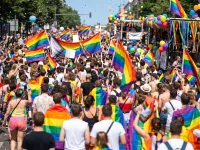
Berlin's first Pride march took place in 1979. Hirschfeld lived to see neither that march nor the end of paragraph 175; he died in 1935. Even so, his Institute was one of the early places where homosexual people were taken seriously: as people seeking advice, as patients, as staff and as researchers. Anyone who marches today continues something that was violently cut off in May 1933.
Photo: by Travel with Lenses on Pexels.
Frequently asked questions
Sources
- hirschfeld.in-berlin.de · wash_en
- germanhistorydocs.org · institut-fuer-sexualwissenschaft-in-berlin-undeutsches-und-w...
- magnus-hirschfeld.de
- britannica.com · Institute-for-Sexual-Science