Corporate sponsors pulled back sharply from Pride events in 2025, leaving organizers from San Francisco to Berlin scrambling to close budget gaps. Here's how Pride funding actually works, and how organizations are adapting.
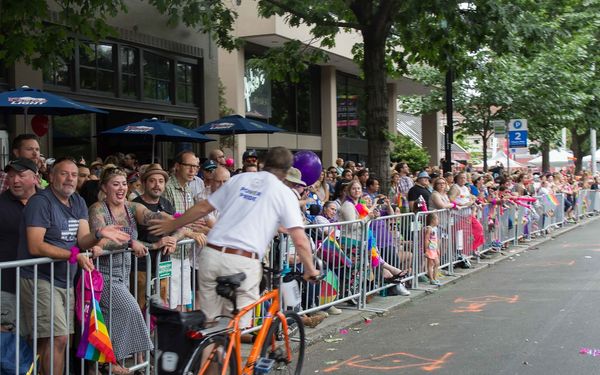
A Pride parade looks effortless from the sidewalk: a stage, a sound system, marshals, permits, often a whole street festival built around it. What almost nobody in the crowd sees is who pays for all of it. Since 2025, that question has become harder to answer, as corporate sponsorship pulled back sharply on both sides of the Atlantic.
The four sources organizers actually rely on
Pride organizations rarely depend on one funding stream. Most combine several.
Earned income usually forms the base: vendor and float fees at the street festival (often tiered for nonprofits versus commercial vendors), membership dues, and ticket sales for closing parties. Municipal support tends to arrive as in-kind help rather than cash: free use of public space, provided stage equipment, street closures handled by city services. Grants from public agencies, foundations, and cultural funds typically cover specific projects rather than the whole event. And corporate sponsorship, usually sold in tiered packages with different levels of visibility on stage, floats, or programs.
For scale: Germany's regional Pride umbrella organization for North Rhine-Westphalia estimates that a march with an accompanying street festival costs at least €10,000 to €25,000, with the stage alone running €2,500 to €5,000, before permits, security planning, or marshals are even factored in.
What that mix looks like on the ground
The scale varies enormously. Madrid's Pride, MADO, brings in more than half its budget from private sponsors, with the city council covering a smaller share: a split that's typical for large marches, where public money covers a symbolic portion and the rest depends on commercial deals renewed year to year. Hamburg Pride e.V., meanwhile, has grown enough on membership dues (over 1,000 members) that it now runs its own grant program funding queer community projects, something few Pride organizations can afford.
Groups without that kind of stable base stay more exposed to individual sponsorship contracts. That exposure is exactly what turned into a problem in 2025.
The 2025 sponsorship pullback
Starting in 2025, a wide range of major corporations scaled back or dropped Pride sponsorships, driven largely by the Trump administration's executive order ending federal diversity, equity, and inclusion programs in the United States. Companies with any exposure to US federal contracts feared losing that business if they kept visibly backing LGBTQ+ events. Brands including Comcast, Diageo, Mastercard, PepsiCo, Target, and Walmart cut sponsorship budgets. US Pride organizations reported shortfalls in the hundreds of thousands to over a million dollars: San Francisco, New York, Washington D.C., and other cities all reported significant gaps.
The effect wasn't confined to the US. Many of the companies pulling back also held sponsorship contracts with Prides in Europe. Berlin had to close a roughly €200,000 gap for its 2025 parade. Munich's city government ended up covering a six-figure shortfall directly from its budget after private sponsors withdrew. Smaller events were hit even harder. A first-year Pride in the German town of Albstadt, which had drawn around 400 participants with state funding, lost that funding entirely for its second edition and had to relocate to nearby Balingen, relying on support from Stuttgart's queer community center to make it happen at all.
It isn't universal. In Dresden, the municipal transit authority kept sponsoring Pride visibly, running rainbow-branded buses and trams, a reminder that public and municipal sponsors aren't under the same pressure private corporations face.
Madrid tells a related but different story: the city council has kept its €500,000 annual contribution to MADO frozen since 2022, even as the event's economic impact on the city grew from an estimated €455 million in 2022 to nearly €900 million in 2025. City officials have openly said Madrid would need closer to €7.5 million to match what other Spanish cities, like Seville, now provide proportionally. The gap has already meant fewer international performers and cuts to grants that used to support local LGBTQ+ organizations like COGAM.
What organizations are doing about it
Germany's federal Queer Commissioner, Sophie Koch, has pushed to replace departing US sponsors with European companies rather than leave the funding gap with the organizing associations themselves. On the ground, many Pride groups are doing what's within their own control: targeted donation campaigns aimed at the community (Berlin Pride ran one for its 2025 edition), crowdfunding, benefit auctions, and a broader base of membership dues instead of a handful of large sponsors.
For anyone organizing a Pride event or trying to shore up an existing one, the lesson from 2025 is fairly plain: the more funding is spread across earned income, municipal support, grants, and several smaller sponsors rather than a few large ones, the less any single pullout can do to the budget. And for the people who show up to march or party, buying a ticket to the official closing event or becoming a paying member of the organizing association isn't just a nice gesture anymore. Increasingly, it's the part of the budget that doesn't depend on whether a corporation renews its contract next year.
Frequently asked questions
Last reviewed: 7. August 2026