
2027 date
The date has not been confirmed yet. Expected August 2027
You will find the date here as soon as it is confirmed. Already know it? Let us know.
Muenster Pride 2026
Muenster Pride programme
Market festival on the Prinzipalmarkt with stalls and stage programme.
Demonstration march through the city center.
Rally after the demonstration.
Official closing party at Jovel.
Hotels around Münster
Tap the map for prices and availability.
About Muenster Pride
Münster carries a particular history when it comes to queer life: the city was home to the first gay demonstration held in West Germany, long before marches like this one took their now-familiar shape. That legacy grew into a tradition still carried today by a small team of volunteers.
The day opens with a demonstration that winds through the city centre and ends at Prinzipalmarkt. There, in front of the Lambertikirche, a street festival unfolds with a stage programme, joined by numerous local associations, initiatives and institutions. Once evening falls, the celebration continues at Jovel, home to the official closing party.
Behind it all stands a team that works through the rest of the year to weave the main day into a longer programme: the Pride Weeks. Workshops, readings, discussion panels and smaller meetups for different communities spread across the city, creating space beyond the main stage.
One thought runs through all of it: visibility matters. Taking to the streets makes clear that queer life belongs in Münster — not just on a single day, but as an ordinary part of the city. That is why the march remains the heart of the event, even as an entire festival has grown up around it.
Getting there is easy, whether by bicycle, bus or on foot, and parking can be found near the centre for those arriving by car. Whether marching, gathering at the square, or joining the evening festivities, the day is an invitation to take part, to listen, and to stand visibly for queer life.
About Muenster
Münster holds a unique place in LGBTQ+ history as the site of Germany's very first demonstration for gay and lesbian rights, marking a pivotal moment that boosted visibility and advocacy for queer communities across the country. This legacy continues to shape the vibrant Pride movement in the city today.
The Pride events in Münster are organized by a dedicated volunteer association working closely with local groups representing gay, lesbian, bi, and trans communities. These celebrations blend activism with festivity, promoting equality and acceptance of sexual and gender diversity. The Pride Week fills the city with diverse activities during the final weeks of summer, including workshops, cultural performances, discussions, and parties that draw crowds from near and far. The highlight is the grand Pride parade on the last Saturday, followed by a street festival and a closing party that unite thousands in celebration.
What sets Münster's Pride apart is its deep roots in local history combined with a forward-looking approach. Influenced by the global Stonewall legacy and the original Christopher Street protests, events here emphasize community solidarity and public engagement. The university town's progressive vibe infuses Pride with youthful energy, featuring student-led initiatives and inclusive programming that welcomes allies. Parades showcase colorful floats, music, and messages of love and rights, transforming city streets into a rainbow haven.
For English-speaking visitors, Münster's Pride offers an authentic German experience: politically charged yet joyfully communal. It highlights Germany's strong legal protections for LGBTQ+ rights while addressing ongoing challenges like trans inclusion and anti-discrimination efforts. The events foster a sense of belonging, with safe spaces for networking, art, and revelry. Whether joining the march or enjoying the festivities, participants find a welcoming atmosphere that celebrates diversity in a picturesque Westphalian setting.
Muenster Pride – frequently asked questions
The demo line-up starts at 1:00 p.m. at Himmelreichallee (Aasee), start is at 2:00 p.m. The route leads via the Ludgeri roundabout and Bült Street to the Prinzipalmarkt in the city centre. Separate meeting points before the start: rainbow families from 1:30 p.m. at the Kanonengraben playground, neurodivergent people from 1:30 p.m. at the Aasee Terraces (upper parking lot), a parents' block on the 'Münster shows its colors' meadow at the Kanonengraben as well as rickshaws for people with mobility impairments from 1:00 p.m. at Schaumburgstraße 11 (registration: blaume@aidshilfe.org).
Bus lines 6 (in the direction of Hiltrup Bahnhof), 8 (in the direction of Nogatstraße) and 17 (in the direction of Krögerweg) go to the "Stadtwerke/Hafen" stop, all from bus platform C2. Parking is available in the Cineplex multi-storey car park (Albersloher Weg 14) or in Stadthaus 3 (Kiesekamps Mühle 1).

Nearby Prides
Dortmund Pride 2026
Essen Pride 2026
Dusseldorf Pride 2026
Cologne Pride 2026
From the magazine
Germany's First Pride (1979): From a Nervous March to a National Tradition
On June 30, 1979, about 450 people marched in Berlin for the first time on the anniversary of Stonewall. A look back at the start of Germany's Pride tradition, the fight against Paragraph 175 and the road to a mass demonstration.
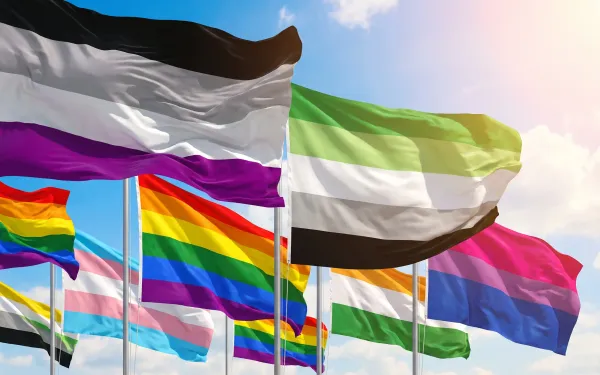
Asexual and Aromantic: What the A in LGBTQIA+ Actually Means
The A in LGBTQIA+ stands for asexual, aromantic and agender, not ally. What these orientations mean, where they differ, and why their visibility at Pride matters.

Pride Anthems: How These Songs Became the Soundtrack of Pride
"I Will Survive," "I'm Coming Out," "Born This Way" turn up at nearly every Pride event. The stories behind how these songs became anthems say a lot about the community that adopted them.